
Sue Kim
Founder & Diamond Concierge, Haejin Jewelry. Williamsburg, Brooklyn.
I fell in love with jewelry before I knew anything about diamonds.
I was thirteen, working at a Hello Kitty store in Flushing, Queens. My parents had immigrated from Korea, and like a lot of first-generation kids, I started working young. That store was full of small, beautiful things. Keychains, charm bracelets, tiny earrings behind a glass case. I used to watch girls my age come in after school, hold something up to the light, try it on, and smile before they even checked the price. Something about that moment stayed with me. The way a small, beautiful thing can make a person feel seen. I did not have the words for it then. I was just a kid in Flushing sorting inventory after school. But that feeling became the foundation of everything I built.
After college I worked in beauty companies, but jewelry kept pulling me back. I did not want to just sell it. I wanted to understand how a ring is actually made. Not the marketing version. The real version. So I traveled. I flew across the country to visit production facilities and foundries. I stood in workshops and watched jewelers pour molten gold into casting molds at 1,900 degrees. I held unfinished rings still rough from the mold and learned to feel the difference between work done with care and work done to hit a number. I studied metalwork, stone setting, finishing, production timelines. I wanted to know every step between raw gold and a ring on someone’s hand, because I knew that one day I would be responsible for the ring on someone’s hand.
That path led me to Manhattan’s Diamond District. 47th Street is one block long and holds more diamonds per square foot than anywhere else on earth. I expected to stay a year. I stayed for many more. Over the course of my career I worked for different companies across the industry, traveling to see how jewelry is created at every stage. I did not want to understand just one part of the process. I wanted to understand all of it.
I will be honest with you about what those years were like.
I was often the only woman in the room. In wholesale offices, at supplier meetings, on the trading floor. Men talked past me. They directed questions to whoever was standing next to me, even when I was the one who knew the answer. I once had a dealer refuse to show me a parcel of diamonds because he assumed I was someone’s assistant. I was the buyer.
I did not fight my way in by being loud. I earned my place by being the most prepared person in every room I walked into. I learned to read an IGI certificate in under thirty seconds. I learned to spot the details that separate a good diamond from a great one: the symmetry grade most buyers skip, the fluorescence note that changes how a stone looks in daylight, the difference between a “very good” cut and an “excellent” cut that most jewelers call close enough. I inspected thousands of diamonds. I built relationships with ethical suppliers and walked away from the ones I would never trust again. This is something that comes with experience. It is not something a website or an algorithm can teach you. After years of holding diamonds in my hands, I can tell which stone looks better in person, even when the specs on paper say they are the same. That instinct does not come from reading a certificate. It comes from seeing thousands of stones and learning what the numbers do not capture.
Eventually, clients started asking for me by name. One was the owner of a multibillion-dollar energy company in South America. Every time he flew to New York, he came directly to me. He once told me it was because I was the only person on that street who never tried to sell him something he did not need. He brought his wife, his daughters, and eventually his son when it was time for an engagement ring. He trusted me with the moments that mattered most to his family. A couple from Europe returned to New York every year and always asked for Sue. They never called ahead to check inventory. They called ahead to make sure I was working that day.
I am proud of those years. I became someone people trusted with their most meaningful purchases. But the longer I stayed, the more I saw what the industry does to the people who walk in without that kind of access.
Here is what most customers never find out about the traditional diamond industry.
A natural diamond that a dealer buys wholesale for $5,000 is sold to a couple for $32,000 or more. That is not an exception. That is standard. On a $4,000 stone, the margin can reach 80%. The sales floors on 47th Street are designed for pressure, not education. A customer is seated, shown a stone, told it is the last one at this price, and pushed to decide before they have had time to breathe. I watched couples walk in holding hands, nervous and hopeful, and walk out quiet, having spent $15,000 more than they needed to on a stone that was not meaningfully better than the one they were shown first. I watched customers get talked over by salespeople who assumed they did not know what they were looking at. I watched people ask smart, specific questions and get vague, condescending answers designed to make them stop asking.
And then there is the part of the industry that no one in the showroom ever talks about.
Natural diamonds come from the earth. That sounds simple until you understand what it actually means. It means open-pit mines in Sierra Leone, the Democratic Republic of Congo, Angola, and Botswana, some stretching miles across and hundreds of feet deep. It means communities displaced from land their families lived on for generations so a mining company could extract what was underneath. It means children as young as five working in artisanal diamond mines in sub-Saharan Africa, sifting through gravel in river beds for stones that will eventually sit in a velvet box on 47th Street. It means families in mining villages who lose their homes, their land, and sometimes their lives to an industry that sells the finished product as a symbol of love.
The Kimberley Process was supposed to fix this. It was created in 2003 to certify that diamonds are “conflict-free.” But the definition of conflict is narrow. A diamond mined by a child is not considered a conflict diamond. A diamond mined after a village was forcibly relocated is not considered a conflict diamond. A diamond mined in a country where the profits fund authoritarian governments is not considered a conflict diamond. The certification covers war. It does not cover suffering.
I stood on 47th Street and watched dealers sell these stones for $30,000, $50,000, $80,000, and hand the customer a certificate and a velvet box and say congratulations. They never mentioned the mine. They never mentioned the village. They never mentioned the child.
I could not keep being part of that.
I did not leave 47th Street because I failed there. I left because I succeeded and could no longer stay quiet about what succeeding in that world required me to tolerate.
I opened Haejin Jewelry in Williamsburg, Brooklyn. Not in Manhattan. Not online. In Brooklyn, because Brooklyn is where people come when they want something real. I named it Haejin because in Korean it means “jewelry formed by the sun.” My parents gave up everything to build a life in Flushing. I wanted my company to carry the language they raised me in. I wanted my work to bring warmth and light to an industry that has operated in the dark for too long.
Today, every diamond in my studio is lab-grown and IGI-certified. A lab-grown diamond is chemically, physically, and optically identical to a mined diamond. Same carbon. Same hardness. Same fire. The only difference is origin and price. The same 2-carat E VS2 stone that costs $28,000 mined costs $2,800 lab-grown. No mine. No displacement. No child labor. No wondering.
I do not carry natural diamonds. Not because they are not beautiful. They are. But because I cannot put a diamond on someone’s hand and ask them to trust me while knowing that I do not fully know where that stone came from or what it cost someone else. Lab-grown diamonds removed that question entirely. The stone is created in a controlled facility, certified by IGI, and traceable from creation to your finger. When I hand you your ring, I can look you in the eye and tell you exactly where every part of it came from. That is the kind of honesty I wanted to build a business on.
Most jewelers in 2026 sell both natural and lab-grown diamonds. They stock both. They let the customer decide. And from a business perspective, that is the safer choice. You never lose a sale because you do not carry what someone is looking for.
I chose not to do that.
I only carry lab-grown. That means every customer who walks in already set on a natural diamond walks right back out. I know that. I lose that sale every time. A jeweler who stocks both never has to make that choice. They can tell one customer they care about ethics and sell lab-grown at noon, then turn around and sell a natural stone with a $20,000 markup at three o’clock. They never have to pick a side. They never have to give anything up.
I picked a side. Not because it is easy. It is not. It is harder. My margins are lower. My market is smaller. I am a one-person studio competing against companies that have both options, larger teams, bigger ad budgets, and no convictions to get in the way of a transaction. Some of those companies market themselves as ethical because they offer lab-grown as an option. But offering an option is not the same as taking a stand. An option is a product. A stand is a sacrifice.
I made this choice because every time I sit across from a couple and show them a beautiful lab-grown diamond for a fraction of what the same stone would cost mined, and I watch the tension leave their shoulders when they realize they do not have to choose between the ring they want and the life they are building together, I know I made the right decision. That moment is not a sale. That moment is the reason this studio exists. And I would rather have that moment every day than capture the customer I lost at the door.
Every setting is made with recycled solid gold. No new mining. Every consultation is one-on-one, unhurried, and led by me personally. I do not employ salespeople. I do not work on commission. I do not upsell. When you ask me if the more expensive option is worth it, I tell you the truth, even when the truth is no. Especially when the truth is no.
Every custom engagement ring at Haejin is crafted right here in New York City by a master jeweler I have worked with for years. Not shipped overseas to a factory where labor is cheap and conditions are unknown. Yes, local craftsmanship costs more. I accept that. Because I know exactly who made your ring, I know the conditions they work in, and I know that if anything ever goes wrong, your ring will be repaired by the same hands that made it. Not sent across the world and back. Right here. Right away. That is worth the difference.
I know what it feels like to be the only woman in a room full of people who assume you do not belong. I know what it feels like to be underestimated, talked over, and dismissed. And I know what it feels like to finally walk away from all of that and build something that is entirely yours.
Haejin is a woman-owned, independently operated studio in Williamsburg, Brooklyn. I am not backed by investors. I am not part of a chain. There is no corporate office deciding what I can and cannot say to you. There is no sales floor. There is no pressure. There is just me, my studio near McCarren Park, and a promise that when you sit down across from me, you will be treated with the honesty and respect that this industry has withheld from its customers for too long.
When you choose Haejin, you are not just buying a ring. You are choosing a woman-owned business over an industry that was never designed to put you first. You are choosing transparency over markups. You are choosing a stone that was created with intention over one that was extracted with force. You are choosing to start your marriage the same way you intend to live it: with clarity, with values, and without compromise.
If you are reading this, you are probably researching engagement rings. You have probably visited five websites already. You are comparing prices, reading reviews, and trying to figure out who you can actually trust. I understand that feeling. I spent a decade surrounded by people who made their living by making sure you never fully understood what you were buying.
I built Haejin for you. Not for the billionaire who flies private to 47th Street. For you. The person doing their research at midnight. The couple having the budget conversation over dinner. The person wondering what happens ten years from now when the ring needs resizing, repair, or servicing. The partner who just wants someone to be honest with them for once.
A couple left this card in my studio after picking up their rings.
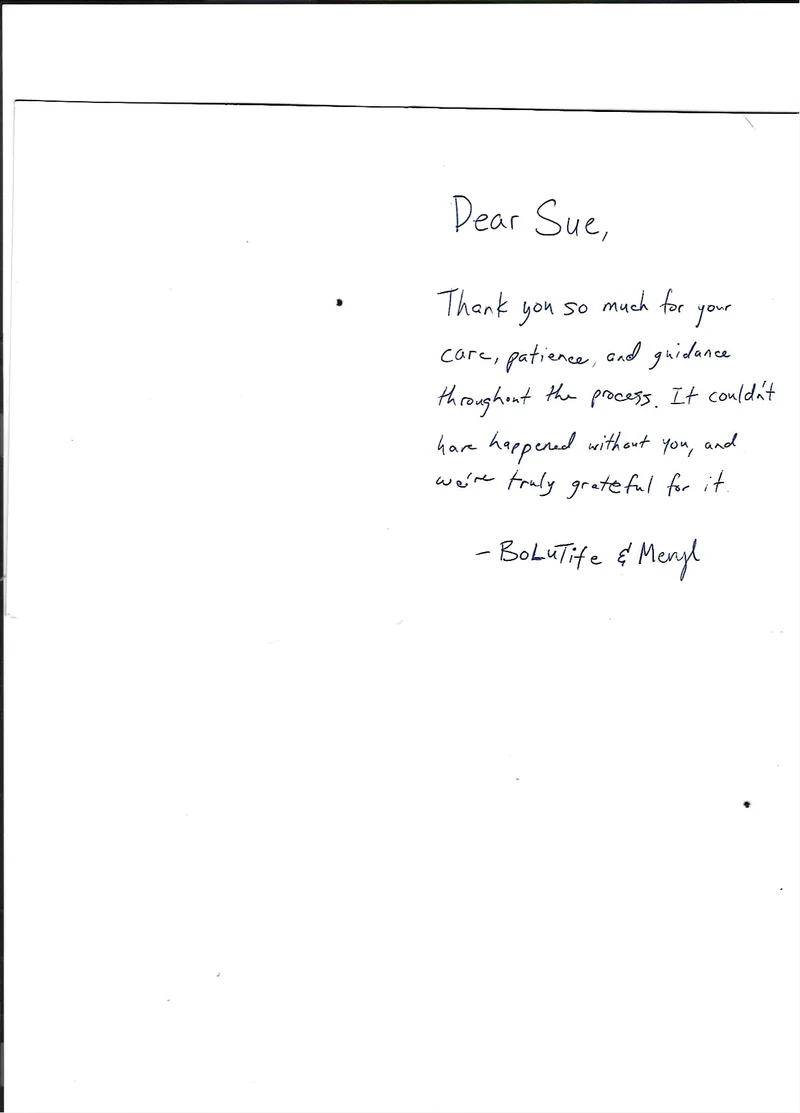
Come sit with me in the studio. I will show you every diamond I have, tell you exactly what each one costs and why, and never once make you feel like you need to decide before you are ready. That is not a sales pitch. That is the reason this studio exists.
Credentials and Accreditations
- 10+ years in the jewelry industry — casting, production, design, diamond sourcing, ethical supply chain management, and private client advisory across multiple companies
- Manhattan's Diamond District veteran — 47th Street wholesale diamond trade, IGI/GIA certification analysis, international client relationships
- GIA Verified Retailer — certified by the Gemological Institute of America
- BBB Accredited Business — Better Business Bureau, A+ Rating
- Nassau College alumni
- Bilingual — fluent in English and Korean
- Woman-owned and independently operated — Williamsburg, Brooklyn since 2024
What I Work On Every Day
I specialize in lab-grown diamond engagement rings and custom ring design for couples in New York City and around the world. Every piece is made to order using IGI or GIA certified lab-grown diamonds and SCS-certified 100% recycled solid gold. Engagement rings at Haejin typically range from $1,500 to $15,000.
Half of all millennial and Gen Z couples now choose lab-grown engagement rings. I believe women today want choices that reflect their values. As I told Brownstoner: "I do not see mined diamonds as the equivalent of wearing real fur, but I do think women today want choices that reflect their values."
Beyond ring design, I offer guidance on topics most jewelers never touch:
Second Opinion Service
Already have a quote from another jeweler? Bring it in. I will review the stone, the setting, and the price with you. No charge, no obligation, total honesty.
Learn more about the Second OpinionProposal Planning
I have helped couples plan proposals at DUMBO, Prospect Park, the Brooklyn Bridge, Central Park, and private rooftops across the city. I share what I have seen work and what to avoid.
Read my proposal guidePre-Marriage Preparation
The ring is the beginning of a conversation, not the end. I talk with couples about what marriage really asks of two people, how to prepare for it honestly, and how to start that chapter with clarity.
Book a conversationJewelry Education
Diamonds, metals, certifications, pricing, settings. I write and teach about all of it so you never have to make a decision in the dark. My guides cover everything from the 4Cs to how much to actually spend.
Read my guidesFeatured In
"A Light in Brooklyn's Diamond Trade: Haejin Jewelry in Williamsburg." Brooklyn's leading publication on design, real estate, and neighborhood life profiled the studio and my journey from the diamond industry to founding an ethical practice.
"The space itself reflects why women choose to shop for engagement rings in Brooklyn instead of Manhattan: it is calm and simple." Brian Keith, Brownstoner, March 2, 2026Read the full Brownstoner feature
Lauren Ladouceur is a NYC-based wedding content creator whose work has been featured in The New York Times, The Wall Street Journal, People Magazine, and The Knot. After visiting the studio, she included Haejin in her 2026 engagement ring shopping guide.
"I'm glad I know her now. Not because anything was wrong with my ring, but because I got confirmation of what the process should look like." Lauren Ladouceur (@planwithlaur), 2026 Engagement Ring GuideRead Lauren's full guide
Brooklyn's oldest newspaper (founded 1841) profiled Haejin Jewelry in a June 2026 feature on why NYC couples are choosing lab-grown diamonds and independent jewelers over chain retailers.
"At Haejin Jewelry, a woman-owned studio in Williamsburg, Brooklyn, Sue Kim designs each ring from scratch using lab-grown diamonds and recycled gold." Brooklyn Eagle, June 2026Read the Brooklyn Eagle feature
What Couples Say
"Sue made me feel like I was her only client. She walked me through every option, never rushed me, and helped me design a ring that was exactly what I imagined but could never find anywhere else." Shea, designed his ring entirely online with Sue, then proposed underwater while scuba diving
"Honestly the whole experience felt like talking to a friend who just happens to know everything about diamonds. Zero pressure. She even told me when something was not worth spending more on." Erin M., Google Review
"We drove three hours to visit Sue in Williamsburg. It was worth every minute. She sat with us for over an hour and never once tried to upsell us." Edward K., Google Review
In My Own Words
"Diamonds should bring joy without causing suffering, beauty without compromise, and meaning beyond materialism." Sue Kim, in Brownstoner
"Real change isn't just about ending bad practices. It's about creating new opportunities." Sue Kim, on the Brooklyn Love Restoration Project
I also write about love, relationships, and the quiet moments I witness in the studio. I share gentle guidance on Brooklyn engagement rings, ethical fine jewelry, proposal planning, and what marriage actually asks of two people. My writing lives on this site and on Medium.
Guides and Essays by Sue
- Custom Engagement Rings NYC: A Gentle Guide for Women Designing a Ring
- How Much Should You Spend on an Engagement Ring in NYC
- Best Places to Propose in Brooklyn and NYC: Romantic Spots, Budgets, Tips
- Toi et Moi Engagement Rings: A Calm Guide to Two-Stone Rings in NYC
- Lab-Grown Diamonds Are Real Diamonds: The FTC Made It Official
- Diamond Certifications Explained: IGI vs GIA vs GCLA
- The Economics of Lab Grown vs Natural Diamonds
- Lab-Grown Diamond Engagement Rings NYC: Complete Buyer's Guide
- Engagement Ring Trends 2026: What Brooklyn Couples Are Choosing
- The Engagement Ring Buying Landscape in NYC
- Best Diamond Shapes for Engagement Rings
- Lab-Grown vs Mined Diamonds: The Honest Truth
- The History of Wearing Rings as a Symbol of Love
- Colored Gemstone Engagement Rings Brooklyn
Find Sue Online
Visit the Studio
123 Skillman Ave STO, Brooklyn, NY 11211
Near McCarren Park, Williamsburg
Tuesday, Thursday, Friday: 11 AM to 5 PM
Saturday: 11 AM to 6 PM
Sunday: 11 AM to 4 PM
917-909-0249
Book a Consultation